
Quick Summary: For most small and mid-sized businesses, managed IT services are cheaper than in-house teams because they offer predictable monthly costs, broader coverage, and easier scalability. In-house IT can be more cost-effective only if you need constant onsite support, custom systems, or tight control, but it comes with higher fixed costs and recruitment risks. As your company grows or needs more complex support, the cost advantage of managed services diminishes, and internal support might make more sense.
For most US SMBs, Managed IT Services cost less than In-House IT once you add pay, benefits, tools, night coverage, and turnover risk. Still, In-House IT can win if you need nonstop onsite help or tight control. This IT Cost Comparison breaks down where Managed IT Services save money, where Managed IT Services earn their price, and when internal support makes more sense.
Managed IT Services vs In-House IT: Cost Factors That Matter Most
| Managed IT Services | In-House IT | |
|---|---|---|
| Total annual cost | Lower for most SMBs; predictable monthly fee | Higher once salary, benefits, and tools are added |
| Upfront investment | Low; minimal hiring and setup cost | High; recruiting, onboarding, and tooling |
| Coverage and availability | 24/7 monitoring and broader coverage | Limited by staffing and business hours |
| Scalability | Easy to scale as headcount grows | Costly to expand with growth |
| Security and compliance | Typically stronger baseline controls and support | Depends on internal skill depth and training |
| Best fit | SMBs needing predictable cost and broad expertise | Businesses needing deep onsite control or proprietary systems |
How Managed IT Services and In-House IT Compare
Managed IT Services
Managed IT services outsource support, monitoring, maintenance, and security for a set monthly fee. They fit SMBs that want broad skills, low upfront cost, and easier scaling, with many providers offering 24/7 coverage and predictable pricing in flat-fee plans.
Key strengths
- Predictable monthly cost
- Low setup burden
- Wider coverage
In-House IT
In-house IT means your own employee or team runs daily support, systems, and operations. It fits firms that need tight onsite control or custom environments, but hiring costs add up fast – the median pay for user support specialists was $59,240 a year before benefits and tools.
What Actually Drives the Cost Difference?
Why salary is only the starting point
Salary is the easy number to see. It is rarely the full cost. In March 2026, private industry employers paid $32.60 per hour in wages and $14.01 more in benefits, so benefits made up about 30.1% of total pay, according to the BLS compensation summary. Add hiring time, training, turnover, tools, backup coverage, and after-hours work, and one IT hire gets expensive fast.
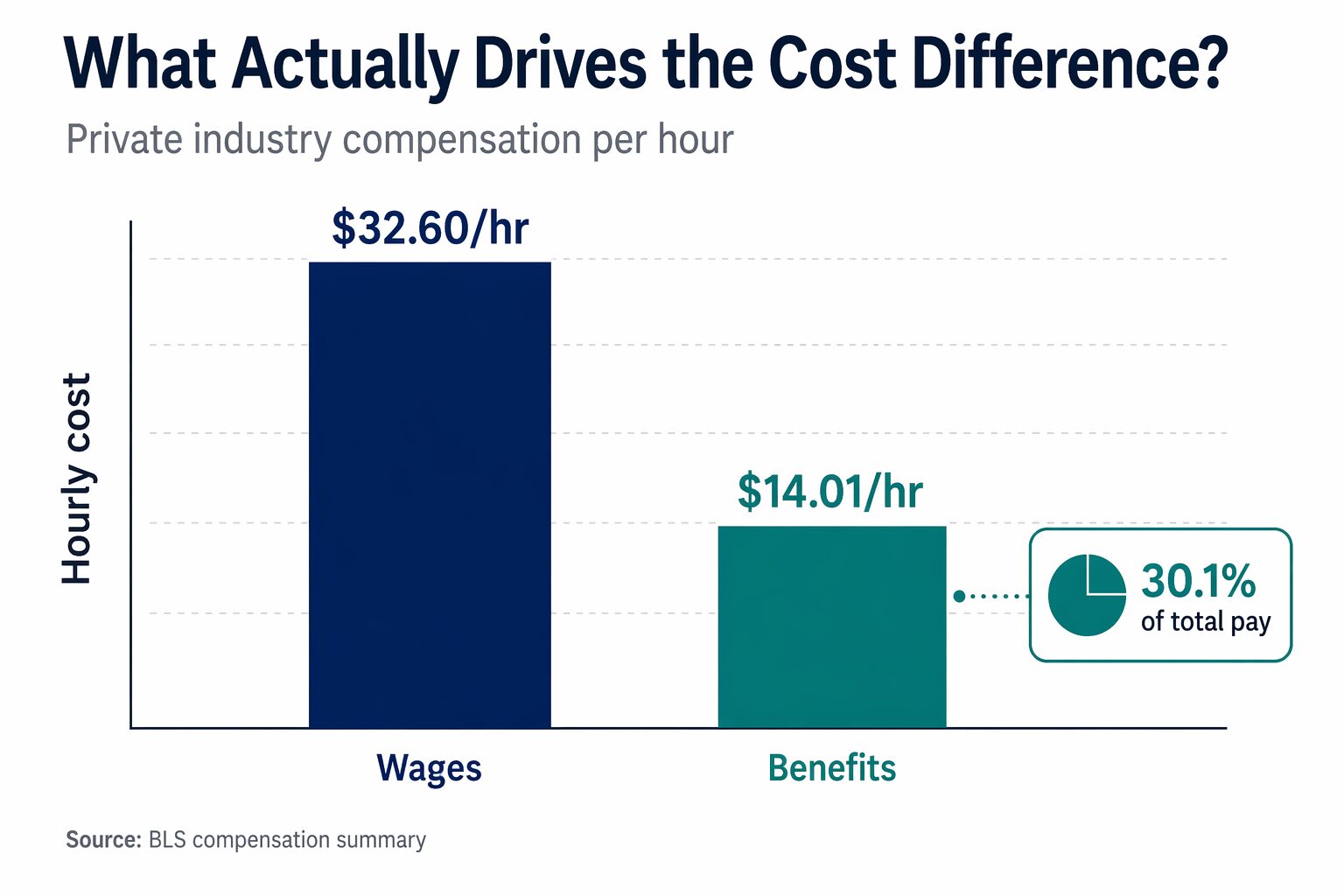
Hidden IT costs usually show up after the hire, not before it.
Why managed services usually flatten the cost curve
Managed services shift many lumpy costs into a steadier monthly fee. You are not carrying full-time payroll, benefits, recruiting risk, or paying extra each time you need a different skill set. That matters for SMBs, since BLS shows smaller firms often carry lower total compensation than large ones, but still face real benefit costs and rising labor pressure from the Employment Cost Index. Managed IT works best when needs change month to month.
How Scalability Changes the Break-Even Point
Growth usually helps managed IT services first. A provider can add users, devices, and security coverage without you hiring a full new employee. That matters because private industry employers paid an average $46.60 per hour in total compensation in March 2026, including $14.01 per hour in benefits according to the BLS compensation summary. So your break-even point moves right as your company grows in small steps, not big staffing jumps.

In-house IT starts to make more financial sense when you have:
- steady headcount
- heavy onsite needs
- complex systems needing daily ownership
That is because one senior IT leader alone carries a high pay floor. The BLS says computer and information systems managers earned a $171,200 median annual wage in May 2024.
If growth is uneven, outsourced support often stays cheaper longer.
Which Should You Choose for the Lowest True Cost?
For most SMBs, managed IT services cost less because the bill is steady and the team is shared. The BLS lists mean pay at about $63,640 for user support and $78,640 for network support before benefits, tools, and hiring costs BLS wage data. If you want fewer surprise costs, pick managed IT.
- Choose managed IT services if you want predictable spend
- Best for firms with 10 to 75 staff
- Easier to budget month to month
- Broader coverage than one hire
Managed IT usually wins on true cost when you need support, security, and after-hours coverage.
- Choose in-house IT if control and onsite presence matter more
- Best if you need daily hands-on support
- Better for custom gear, plant floors, or strict internal control
- Expect higher fixed labor cost as roles grow
For a deeper breakdown, go back to the parent pillar post on managed IT services vs in-house IT cost.
Cut IT waste and reduce risk with SR Technical Consultants. Get expert managed IT guidance, cost control, and security support.
Frequently Asked Questions
Q1: What are the key cost differences between managed IT services and in-house IT for small to mid-sized US businesses?
Managed IT usually turns fixed staffing costs into a monthly fee. In-house IT adds salary, benefits, training, tools, overtime, and turnover costs.
Q2: How does scalability impact the decision to choose managed IT services versus maintaining an in-house IT team in the US?
Managed services scale faster when you add users, sites, or security needs. In-house teams often need new hires, which raises cost and slows response.
Q3: What security and compliance advantages do managed IT providers offer over in-house IT for US organizations?
Managed providers often bring broader security coverage, documented processes, 24-7 monitoring, and audit support. Small in-house teams may lack that depth or time.
Conclusion
Managed IT usually costs less for SMBs until growth, onsite needs, or custom systems justify internal staff. Wage pressure stays real, as BLS security analyst data and computer support pay data show.